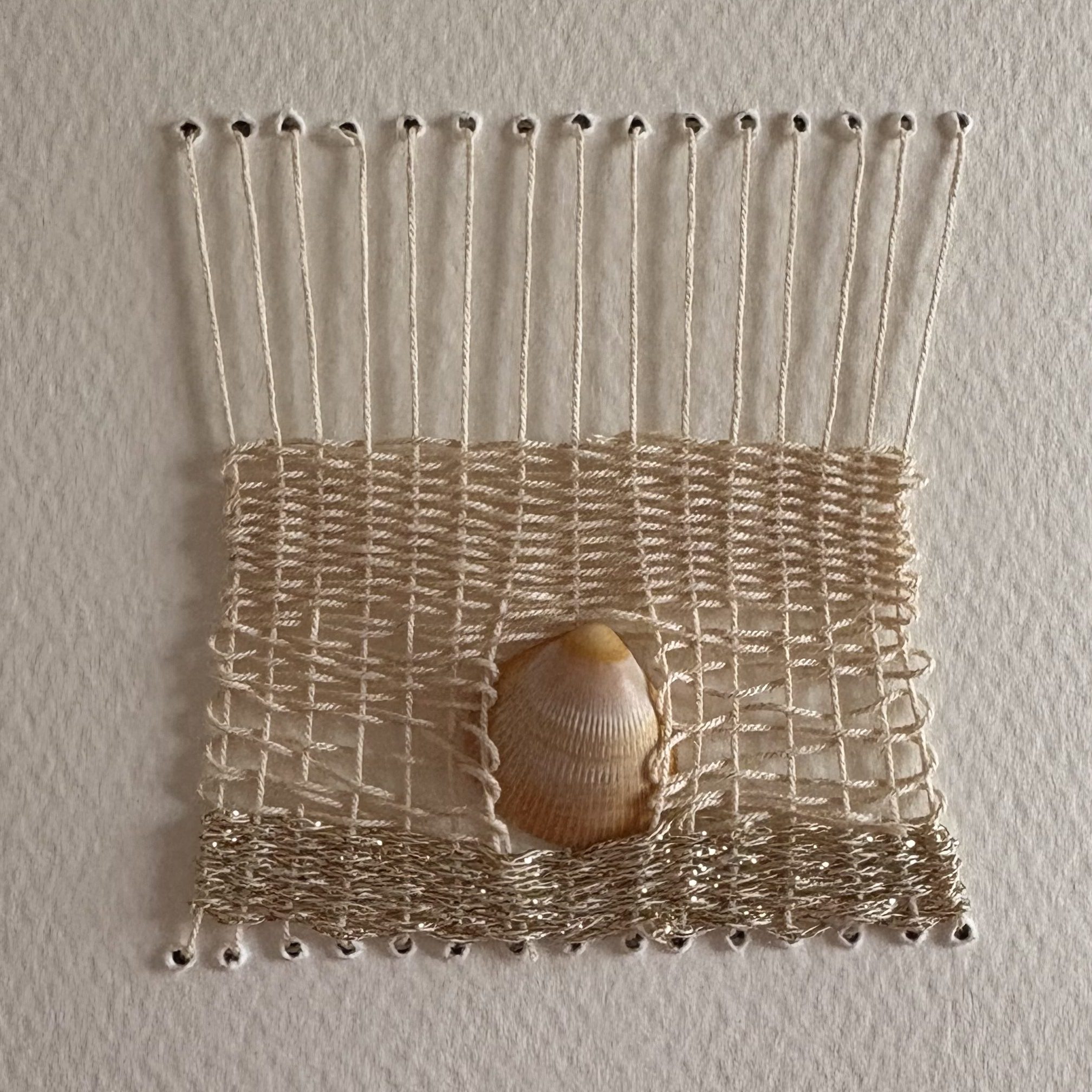
Na imagem é possível ver uma tecitura em algodão, viscose e poliéster com uma pequena concha que catei na Costa da Caparica.
Tem sido muito interessante fazer essas pequenas amostras em materiais diversos como: algodão, linho, lã, viscose e poliéster a partir de uma folha de papel de algodão. Foi a partir do livro Contemporary weaving in mixed media (2022) da autora Rachna Garodia, e conversa com amigos, que surgiu essa vontade de experimentação em pequenos formatos.
É um jeito muito curioso de pensar o macrocosmo da tecelagem, da tapeçaria, a movimentação dos fios a partir de amostras menores, entender o tridimensional dentro do bidimensional. Erguer os fios brancos como o papel, é uma forma de criar uma extensão da folha, estender a materialidade do papel de algodão para fio de algodão e depois ocupar com outros materiais esse entre espaços, entre o papel, entre o fio, entre o algodão ou o linho.
É como um abraço matérico, os materiais se entrelaçam e as texturas dialogam entre camadas que ocupam diversos espaços. Frente e verso, mas o verso aqui está escondido, é possível esconder o verso de um tecido ou uma tapeçaria quando prendem ela a parede, quando prendem em algum suporte ou até quando o verso é coberto por outro material. Entretanto, tem um tempo que aprendi a não ter vergonha do verso, o verso é o cérebro, a memória dessa tecnologia que é tecer.
Mas quando você tece em papel, o verso fica desconhecido, até pra mim, é um verso que nunca vi. É engraçado desconhecer o verso, me faz querer vê-lo. Aí as vezes eu tento espiar pela lateral, entre o papel e os fios, é um jogo de pique-esconde entre eu e o desconhecido.
Recentemente descobri que tem um livro da Sheila Hicks chamado Weaving as Metaphor (2006) e obviamente não tive acesso ainda a esse livro, tem algumas poucas fotos de trabalhos que estão presentes no livro disponíveis na internet. Desde que eu li o nome pela primeira vez, e vi os pequenos trabalhos da Sheila Hicks, já que eu conhecia majoritariamente os colossais, fiquei completamente obcecada com a ideia de Weaving as Metaphor, tecer como metáfora, que bonito isso.
Tecer como algo com várias camadas de significados além do que se pode ver Também é possível interpretá-la de maneira literal, o tapete ou a tecelagem como resultado dela mesmo, mas é mais que isso, são camadas de fios, de amostras, de objetos, de retalhos que são sobrepostos uns aos outros. Uma verdadeira analise combinatória têxtil.
Tenho pensado muito sobre as formas de amor, sim tenho lido Tudo Sobre o Amor (1999) da Bell Hooks, e a importância de tratar as crianças com respeito, como o respeito é parte fundamental do amor. E como o amor pode ser revolucionário, o ato de odiar alguma coisa tem sido um motor muito fundamental na minha vida nos últimos anos, talvez tenha algo a ver com os resquícios tardios da adolescência. Ainda assim, os fios, o tecido, a tecelegem, a tapeçaria, os bordados tem me ensinado muito sobre o amor, sobre amar algo novo, respeitar os materiais, as histórias e todas as pessoas que vieram antes, respeitar também as que vem depois, entender que o conhecimento é muito maior do que um livro de antropologia algum dia será capaz de explicar.
Amar é uma metáfora de tecer.
(EN)
In the image, you can see a weave made of cotton, viscose, and polyester with a small shell that I picked up on the Costa da Caparica.
It has been very interesting to make these small samples in different materials such as cotton, linen, wool, viscose, and polyester from a sheet of cotton paper. It was from the book Contemporary weaving in mixed media (2022) by author Rachna Garodia, and conversations with friends, that this desire to experiment in small formats arose.
It is a very curious way of thinking about the macrocosm of weaving, tapestry, the movement of threads from smaller samples, understanding the three-dimensional within the two-dimensional. Raising the white threads like paper is a way of creating an extension of the sheet, extending the materiality of cotton paper to cotton thread and then filling the spaces between the paper, between the thread, between the cotton or linen with other materials.
It is like a material embrace, the materials intertwine and the textures dialogue between layers that occupy different spaces. Front and back, but the back here is hidden. It is possible to hide the back of a fabric or tapestry when it is attached to the wall, when it is attached to a support, or even when the back is covered by another material. However, there was a time when I learned not to be ashamed of the back. The back is the brain, the memory of this technology that is weaving.
But when you weave on paper, the back remains unknown, even to me, it is a back I have never seen. It’s funny not knowing the back, it makes me want to see it. So sometimes I try to peek from the side, between the paper and the threads, it’s a game of hide-and-seek between me and the unknown.
I recently discovered that there is a book by Sheila Hicks called Weaving as Metaphor (2006) and obviously I haven’t had access to this book yet, there are a few photos of works that are in the book available on the internet. Ever since I first read the name and saw Sheila Hicks’ small works, since I was mostly familiar with her colossal ones, I became completely obsessed with the idea of Weaving as Metaphor. How beautiful that is.
Weaving as something with multiple layers of meaning beyond what can be seen. It is also possible to interpret it literally, the rug or the weaving as the result itself, but it is more than that, it is layers of threads, samples, objects, scraps that are superimposed on each other. A true combinatorial textile analysis.
I have been thinking a lot about the forms of love, yes, I have been reading All About Love (1999) by Bell Hooks, and the importance of treating children with respect, how respect is a fundamental part of love. And how love can be revolutionary, the act of hating something has been a very fundamental driving force in my life in recent years, perhaps it has something to do with the lingering remnants of adolescence. Still, the threads, the fabric, the weaving, the tapestry, the embroidery have taught me a lot about love, about loving something new, respecting the materials, the stories, and all the people who came before, respecting those who come after, understanding that knowledge is much greater than any anthropology book will ever be able to explain.
Loving is a metaphor for weaving.
 Água Viva
Deixe um comentário