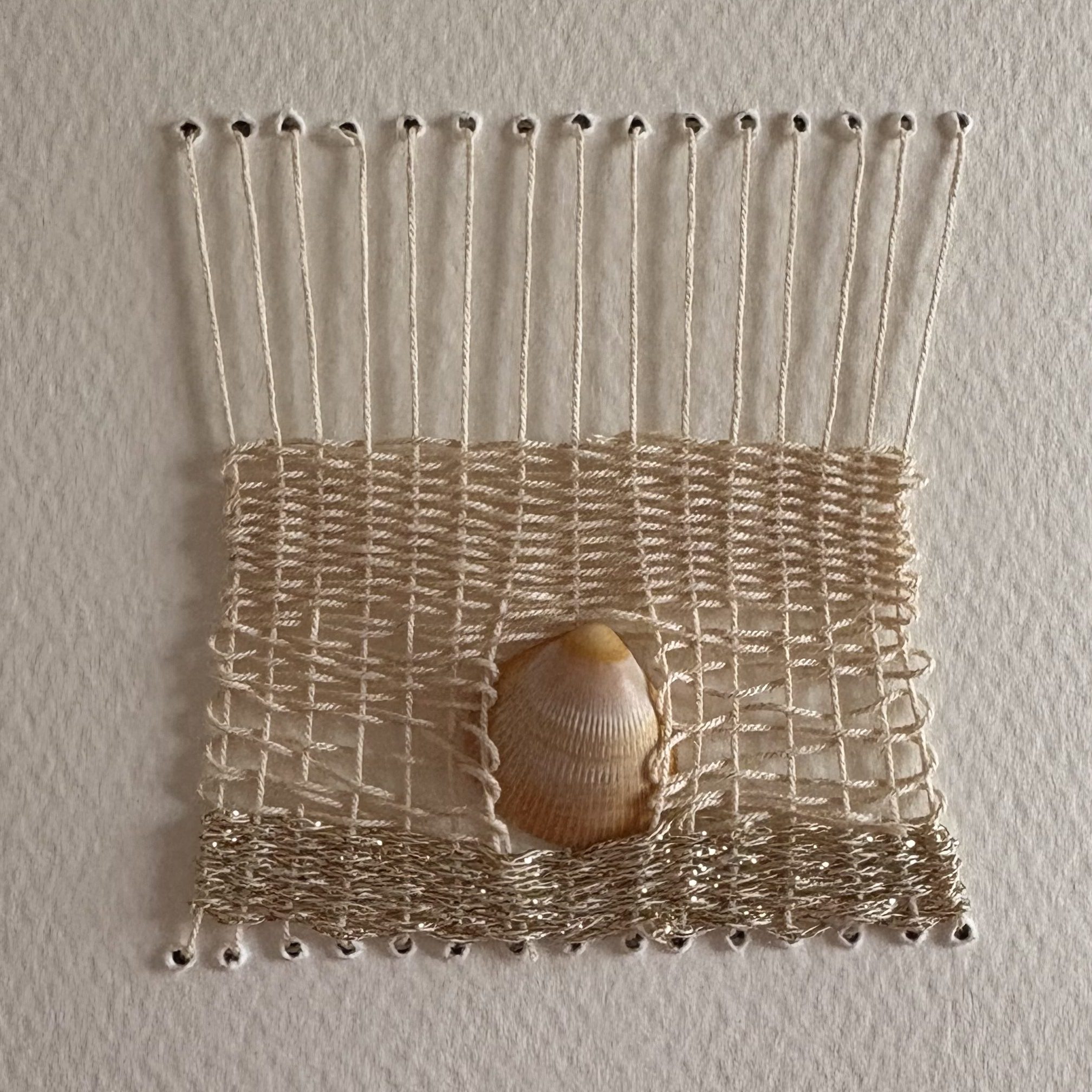
Na imagem é possível ver uma tecitura em algodão, viscose e poliéster com uma pequena concha que catei na Costa da Caparica.
Tem sido muito interessante fazer essas pequenas amostras em materiais diversos como: algodão, linho, lã, viscose e poliéster a partir de uma folha de papel de algodão. Foi a partir do livro Contemporary weaving in mixed media (2022) da autora Rachna Garodia, e conversa com amigos, que surgiu essa vontade de experimentação em pequenos formatos.
É um jeito muito curioso de pensar o macrocosmo da tecelagem, da tapeçaria, a movimentação dos fios a partir de amostras menores, entender o tridimensional dentro do bidimensional. Erguer os fios brancos como o papel, é uma forma de criar uma extensão da folha, estender a materialidade do papel de algodão para fio de algodão e depois ocupar com outros materiais esse entre espaços, entre o papel, entre o fio, entre o algodão ou o linho.
É como um abraço matérico, os materiais se entrelaçam e as texturas dialogam entre camadas que ocupam diversos espaços. Frente e verso, mas o verso aqui está escondido, é possível esconder o verso de um tecido ou uma tapeçaria quando prendem ela a parede, quando prendem em algum suporte ou até quando o verso é coberto por outro material. Entretanto, tem um tempo que aprendi a não ter vergonha do verso, o verso é o cérebro, a memória dessa tecnologia que é tecer.
Mas quando você tece em papel, o verso fica desconhecido, até pra mim, é um verso que nunca vi. É engraçado desconhecer o verso, me faz querer vê-lo. Aí as vezes eu tento espiar pela lateral, entre o papel e os fios, é um jogo de pique-esconde entre eu e o desconhecido.
Recentemente descobri que tem um livro da Sheila Hicks chamado Weaving as Metaphor (2006) e obviamente não tive acesso ainda a esse livro, tem algumas poucas fotos de trabalhos que estão presentes no livro disponíveis na internet. Desde que eu li o nome pela primeira vez, e vi os pequenos trabalhos da Sheila Hicks, já que eu conhecia majoritariamente os colossais, fiquei completamente obcecada com a ideia de Weaving as Metaphor, tecer como metáfora, que bonito isso.
Tecer como algo com várias camadas de significados além do que se pode ver Também é possível interpretá-la de maneira literal, o tapete ou a tecelagem como resultado dela mesmo, mas é mais que isso, são camadas de fios, de amostras, de objetos, de retalhos que são sobrepostos uns aos outros. Uma verdadeira analise combinatória têxtil.
Tenho pensado muito sobre as formas de amor, sim tenho lido Tudo Sobre o Amor (1999) da Bell Hooks, e a importância de tratar as crianças com respeito, como o respeito é parte fundamental do amor. E como o amor pode ser revolucionário, o ato de odiar alguma coisa tem sido um motor muito fundamental na minha vida nos últimos anos, talvez tenha algo a ver com os resquícios tardios da adolescência. Ainda assim, os fios, o tecido, a tecelegem, a tapeçaria, os bordados tem me ensinado muito sobre o amor, sobre amar algo novo, respeitar os materiais, as histórias e todas as pessoas que vieram antes, respeitar também as que vem depois, entender que o conhecimento é muito maior do que um livro de antropologia algum dia será capaz de explicar.
Amar é uma metáfora de tecer.
(EN)
In the image, you can see a weave made of cotton, viscose, and polyester with a small shell that I picked up on the Costa da Caparica.
It has been very interesting to make these small samples in different materials such as cotton, linen, wool, viscose, and polyester from a sheet of cotton paper. It was from the book Contemporary weaving in mixed media (2022) by author Rachna Garodia, and conversations with friends, that this desire to experiment in small formats arose.
It is a very curious way of thinking about the macrocosm of weaving, tapestry, the movement of threads from smaller samples, understanding the three-dimensional within the two-dimensional. Raising the white threads like paper is a way of creating an extension of the sheet, extending the materiality of cotton paper to cotton thread and then filling the spaces between the paper, between the thread, between the cotton or linen with other materials.
It is like a material embrace, the materials intertwine and the textures dialogue between layers that occupy different spaces. Front and back, but the back here is hidden. It is possible to hide the back of a fabric or tapestry when it is attached to the wall, when it is attached to a support, or even when the back is covered by another material. However, there was a time when I learned not to be ashamed of the back. The back is the brain, the memory of this technology that is weaving.
But when you weave on paper, the back remains unknown, even to me, it is a back I have never seen. It’s funny not knowing the back, it makes me want to see it. So sometimes I try to peek from the side, between the paper and the threads, it’s a game of hide-and-seek between me and the unknown.
I recently discovered that there is a book by Sheila Hicks called Weaving as Metaphor (2006) and obviously I haven’t had access to this book yet, there are a few photos of works that are in the book available on the internet. Ever since I first read the name and saw Sheila Hicks’ small works, since I was mostly familiar with her colossal ones, I became completely obsessed with the idea of Weaving as Metaphor. How beautiful that is.
Weaving as something with multiple layers of meaning beyond what can be seen. It is also possible to interpret it literally, the rug or the weaving as the result itself, but it is more than that, it is layers of threads, samples, objects, scraps that are superimposed on each other. A true combinatorial textile analysis.
I have been thinking a lot about the forms of love, yes, I have been reading All About Love (1999) by Bell Hooks, and the importance of treating children with respect, how respect is a fundamental part of love. And how love can be revolutionary, the act of hating something has been a very fundamental driving force in my life in recent years, perhaps it has something to do with the lingering remnants of adolescence. Still, the threads, the fabric, the weaving, the tapestry, the embroidery have taught me a lot about love, about loving something new, respecting the materials, the stories, and all the people who came before, respecting those who come after, understanding that knowledge is much greater than any anthropology book will ever be able to explain.
Comigo não fazes farinha / farinha pouca, meu pirão primeiro.
Ontem no almoço meu namorado fez um peixe, eu falei que parecia uma moqueca, sem dendê, sem leite de coco, e ainda assim com gosto de moqueca, sorte a dele e a minha. Ou talvez, a saudade de comer uma moqueca me fez sentir um gosto que não existia, a saudade tem dessas. Eu comentei que faltava uma farofinha. Ele me disse, “tem ai”. Eu indignada, “não tem não”. O que tinha era farinha. “Qual a diferença?” ” Com a farinha se faz a farofa, mas a farinha passa longe de ser farofa.” Começamos então uma conversa sobre a expressão portuguesa “comigo não fazes farinha”, nunca tinha ouvido, às vezes temos expressões em comum, às vezes não…
Comigo não fazes farinha, não me engana, não me divide em pequenos pedaços ao ponto de me transformar em pó. Aproveita que quer me fazer de farinha e faz uma farofa também, quem sabe um pirão de mim. Eu nunca tinha ouvido essa expressão. Gostei bastante da ideia de transformar uma pessoa em farinha, no sentido poético da coisa. Também a ideia de ser uma mandioca, um aipim, uma macaxeira; acontece que às vezes eu sou bem literal.
Em Salvador usamos muito a expressão “farinha pouca, meu pirão primeiro”, mas o significado é mais gustativo, é que a palavra “pirão” tem sabor e quando se trata de pirão, é melhor garantir logo o seu. Foi engraçada a coincidência de ter uma conversa sobre farinha na mesma semana em que saiu uma lista onde o pirão ficou em oitavo lugar no top 50 melhores “mingaus” do mundo. E mesmo pra quem nunca comeu um pirão – sinto muito –se ele ocupa o oitavo lugar de uma lista só de “papas” em uma guia gastrônomico internacional, é possível imaginar alguma coisa. Na verdade, tem toda uma expressão popular da qual as pessoas não tem nenhuma vergonha em se assumir egoístas na hora de dividir o pirão, isso vale mais que qualquer ranking, o pirão é soberano.
Entretanto, a origem da expressão é muito mais severa: está ligada à fome. No momento da necessidade, na hora do vamo vê, o que vale é garantir o bem-estar antes de qualquer coisa. É possível perceber o poder do território nas palavras. Nada novo, apenas reflexo infinito.
(EN)
With me, you don’t make flour / little flour, my pirão first.
Yesterday at lunch, my boyfriend made fish, and I said it looked like moqueca, without palm oil or coconut milk, but still tasting like moqueca. Lucky for him and me. Or maybe my longing to eat moqueca made me taste something that wasn’t there. That’s how longing works. I commented that it needed some farofa. He said, “It’s there.” I was indignant, “No, it’s not.” What was there was flour. “What’s the difference?” “Flour is used to make farofa, but flour is far from being farofa.” We then started a conversation about the Portuguese expression “comigo não fazes farinha” (you can’t make flour with me). I had never heard it before. Sometimes we have expressions in common, sometimes we don’t…
With me, you don’t make flour, you don’t fool me, you don’t divide me into small pieces to the point of turning me into powder. Take advantage of the fact that you want to make me into flour and make some farofa too, maybe even a pirão out of me. I had never heard that expression before. I really liked the idea of turning a person into flour, in the poetic sense of the word. Also the idea of being a cassava, a manioc, a macaxeira; it turns out that sometimes I’m very literal.
In Salvador, we often use the expression “farinha pouca meu pirão primeiro” (little flour, my pirão first), but the meaning is more gustatory, it’s that the word “pirão” has flavor and when it comes to pirão, it’s better to secure yours right away. It was funny that we had a conversation about flour in the same week that a list came out where pirão ranked eighth in the top 50 best “porridges” in the world. And even for those who have never eaten pirão – I’m sorry –but if it ranks eighth on a list of only “porridges” in an international gastronomic guide, you can imagine something. In fact, there is a popular expression that people are not ashamed to admit to being selfish when it comes to sharing pirão, which is worth more than any ranking. Pirão is supreme.
In fact, the origin of the expression is much more serious: it is linked to hunger, to times of need, to moments of truth, when what matters most is ensuring well-being above all else. It is possible to perceive the power of territory in words. Nothing new, just an infinite reflection.
Ontem à noite assisti ao filme Le bonheur (1965), da diretora Agnès Varda. A primeira vez que tive contato com Agnès foi em 2019, o ano em que ela faleceu. Na verdade, isso acontece comigo as vezes: conhecer o trabalho de uma artista após a sua morte. O ano em que eu cheguei a Portugal, 2022, foi também o ano em que conheci as pinturas da artista portuguesa Paula Rego.
Mas voltando à Agnès, conheci a diretora após me convidarem para desenvolver um troféu para uma mostra de cinema intitulada Lugar de mulher é no cinema (2019), cuja homenageada daquele ano foi justamente Agnès Varda. Nunca tinha assistido a nenhum filme dela. Na verdade, dá um pouco de vergonha admitir, mas aNouvelle Vague nunca foi exatamente o meu movimento favorito – ao contrário das minhas amigas, que amavam Godard e Truffaut. Varda, sinceramente, não tinha ouvido falar.
Fui procurar sobre ela na internet e, ainda hoje, acho engraçado como simpatizei com o rosto dela logo de primeira. Parecia alguma amiga do meu pai que eu conheci, mas havia esquecido – uma sensação muito estranha e familiar ao mesmo tempo. Naquele momento, eu estava entre mil coisas: mudança de casa, escrita do projeto para o mestrado, criação de um troféu… Tentei assistir a um dos filmes da mostra, mas não consegui. Acabei não conhecendo o trabalho da senhora antes de homenageá-la – com dez replicas, em madeira, inspiradas no rosto de Varda.
Bom, seis anos após esse primeiro encontro desencontrado, finalmente assisti a um filme da Agnès Varda. E, claro, amei. Mas já comecei a assistir sabendo que não teria como não amar. Afinal, eu a conheço há seis anos – seis anos lendo matéria sobre ela, vendo fotografias, textos de pessoas apaixonadas pelo seu trabalho. Era como se eu estivesse tentando aprender um pouco sobre ela antes de ver, de fato, sua obra. E, confesso, tive também um certo medo de, por algum motivo, eu não gostar do trabalho da Varda. Imagina só, que vergonha – que tipo de feminista seria eu?
Mas achei o filme de uma força e beleza magistral. Que cores, que detalhes! Ou, como disse o meu namorado: “parece propaganda do Estado Novo”. Sim, parece, intencionalmente. Uma vida de dona de casa idealizada, uma grande propaganda, que só funciona para um lado. A felicidade segundo quem?
O filme me fez lembrar dos trabalhos da artista Martha Rosler, como House Beautiful: Bringing the War Home (1967-72) e Semiotics of the Kitchen (1972). Obras importantes que criticam justamente esse imaginário construído em torno da posição da mulher na sociedade – e da constante alegria que ela deve exibir diante do lar, da família e da vida.
E é essa “perfeição” – imposta pelos homens – que transforma o casamento em um estado autoritário, tão bem representado no filme. A violência no filme, não parte diretamente do François, o protagonista. Como poderia? Ele é a gentileza, o amor, a felicidade em pessoa. As mulheres orbitam ao seu redor, como luas – sem brilho próprio ou, melhor dizendo, refletindo o brilho descomprometido de François.
Dentro dessa reflexão sobre a posição da mulher – diante da casa, da cozinha, do trabalho -, penso sempre nesse estado autoritário que nos foi imposto. Durante muito tempo, acreditei que fosse algo do passado. Mas agora, mais velha, comecei a entender o passado como algo paralelo e não tão distante. Por muito tempo, vi o passado como algo que já passou. Mas, nesse caso, as palavras foram muito injustas com as minorias.
A palavra“passado” só favorece quem deseja que certas coisas sejam esquecidas. Prefiro a palavra “história” – ainda que ela também possa ser confundida com algo inventado, criado e muito distante do presente. Dito isso, concordo que a história da mulheres e das ex-colônias são muito semelhantes. Nós, mulheres, fomos colonizadas pelos homens. Regras nos foram impostas, território delimitados. E, assim como nas ex-colônias, a nossa história tem pouco mais de cem anos de mudança – e isso não é nada perto dos outros quinhentos.
É por isso que as leituras que faço das feministas dos anos setenta são tão atuais. Talvez cinquenta anos pareça muito no tempo humano – afinal vivemos em média setenta. Vinte desses estamos aprendendo a viver, e os outros cinquenta… tentando mudar algo que, provavelmente, não veremos mudar.
Dito isso, porque esse post se chama Tamarindo e tem a imagem de um trabalho meu feito em tecelagem? Bom, para mim, tudo está completamente conectado. Tenho desenvolvido uma série de trabalhos com tamarindos dentro dessa reflexão sobre ser mulher e imigrante – vivendo justamente no país que colonizou o Brasil. Seria impossível não chegar a essa conexão. Falar sobre feminismo e decolonialidade faz todo sentido quando você é uma mulher imigrante. É como se essas reflexões tomassem café da manhã com você todos os dias.
Eu não planejei esse tema – ele me encontrou. Tudo começou com uma sensação muito engraçada: sentir saudade de coisas simples, como comidas e frutas. Passei a me conectar com esse choque cultural entre os sabores que não faziam parte do meu cotidiano e as frutas das quais eu sentia falta.
Então, um dia, eu encontrei tamarindo no mercado. Não é uma fruta que se acha com facilidade nos grandes supermercados portugueses, mas lá estava: um tamarindo. Comprei, muito feliz com a ideia de que, ao comer aquela fruta, seria transportada de volta aos dias de estudante na Escola de Belas Artes – quando comprava um saco de tamarindo em frente à universidade e comia na sala de aula. Um azedo horroroso, que só quem sente prazer em doer os dentes com tamarindo pode entender.
Comprei, não sei ao certo, mas algo como duzentas gramas, talvez nem isso. Cheguei em casa e quebrei um.
Doce.
Sim, o tamarindo, em Portugal, é doce. Parece mais uma tâmara, tentei contar isso para todas as pessoas que eu sabia que conheciam o tamarindo azedo, e elas não acreditaram em mim. Acreditaram, talvez, mas não entenderam. A vivência é realmente algo muito individual. Acho que, se tivessem me contado que existia tamarindo doce, eu também não acreditaria. Assim como talvez não faça sentido, para alguém que só conhece o tamarindo doce, imaginar o quão azedo ele pode ser – pior que limão.
Fiquei mais incrédula com isso do que talvez outras pessoas. Como pode ser doce? De onde vem esse tamarindo? E o tamarindo brasileiro – é realmente brasileiro?
E assim eu comecei a investigar a origem do tamarindo e descobri que aquele que eu havia comprado vinha da Tailândia. Ok, eu já sabia que os tailandeses usavam tamarindo – o Pad Thai , por exemplo, leva molho de tamarindo. Inclusive, tem uma história política muito interessante por trás da produção do Pad Thai como parte de um projeto nacionalista tailandês para construção de identidade cultural.
Dentro desse interesse pelo Tamarindo, descobri que ele foi levado para o Brasil pelos portugueses, vindo de Africa. A partir disso, comecei a pensar em todas as frutas das quais eu sentia saudades e descobri que a grande maioria das frutas que eu sentia saudade não era originalmente brasileira. Ou seja, tinham chegado junto com os portugueses.
E isso me deixou um pouco chateada. Frustrada, talvez. Essas frutas que pra mim sempre representaram afeto, infância, pertencimento, eram, na verdade, recordações de um período de violência. Frutos de outro tipo de relação.
Como artista visual, costumo pensar com as mãos – compartilhando pensamentos por meio de produção, plantando para colher. Foi assim que decidi explorar o tamarindo como a fruta de muitas sementes. O tamarindo doce e azedo; fruta da memória boa, mas também da ruim. Uma fruta que também é tronco. Visualmente, ela é muito interessante: uma casca fina que se parte com facilidade – mas não tão facilmente assim. O tamarindo se parece muito comigo, com a minha vivência em Portugal. Mas também me lembra a história das mulheres – sobre a dualidade de nascer mulher, do agridoce que é ser tamarindo.
É engraçado como uma fruta, ou uma comida, pode ser motivo de tanta reflexão. Mas é assim: fruta também é memória afetiva. Enquanto escrevia sobre o tamarindo, me lembrei do livro Chão de canela (2022), da autora Olinda Beja, que tive o prazer de comprar diretamente com ela. Chão de canela é um livro de contos, que compartilha a memória afetiva e também a travessia -nesse caso, da canela, especiaria que Beja chama de “…a mais viajada.” É um livro que a autora compartilha o afeto pela terra de onde veio, São Tomé, mas também com as amizades e amores que construiu ao longo do caminho.
Para concluir, a simbologia alimentar tem feito muito sentido para mim nesse momento – mas não é tudo. É um parte de muitas coisas que me interessam, é possibilidade de experimentação.
(EN)
Last night, I watched the film Le Bonheur (1965), directed by Agnès Varda. The first time I came into contact with Agnès was in 2019, the year she passed away. Actually, that tends to happen to me — discovering an artist’s work only after their death. The year I arrived in Portugal, 2022, was also the year I first encountered the paintings of the Portuguese artist Paula Rego.
But back to Agnès — I first heard of her when I was invited to design a trophy for a film festival called Lugar de Mulher é no Cinema (2019), and that year’s honoree was Agnès Varda. I had never watched any of her films. In fact, I’m a bit ashamed to admit it, but the Nouvelle Vague was never really my favorite movement — unlike my friends, who adored Godard and Truffaut. As for Varda, honestly, I had never even heard of her.
I looked her up online, and to this day I find it funny how I instantly felt a connection to her face. She looked like one of my dad’s friends — someone I had met but somehow forgotten. It was such a strange and familiar feeling at the same time. Back then, I was in the middle of a thousand things: moving house, writing my master’s project, designing a trophy… I tried to watch one of the films from the festival, but I couldn’t. I didn’t get to know her work before honoring her — with ten replicas in wood, inspired by Varda’s face.
Well, six years after that first missed encounter, I finally watched a film by Agnès Varda. And, of course, I loved it. But I already started watching it knowing I would love it. After all, I’ve “known” her for six years — six years reading articles about her, seeing photographs, and reading the words of people deeply in love with her work. It was as if I had been trying to get to know her before actually seeing her films. And, I must confess, I was a bit afraid that, for some reason, I wouldn’t like Varda’s work. Imagine that — what kind of feminist would I be?
But I found the film to be powerful and breathtakingly beautiful. The colors, the details! Or, as my boyfriend said: “It looks like a propaganda piece from the Estado Novo.” And yes — it does, intentionally. An idealized housewife life, a grand piece of propaganda that only works for one side. Happiness, according to whom?
The film reminded me of works by the artist Martha Rosler, like House Beautiful: Bringing the War Home (1967–72) and Semiotics of the Kitchen (1972) — important works that critique the imaginary constructed around the woman’s role in society, and the constant joy she’s expected to show in relation to the home, the family, domestic life.
And it’s this idea of “perfection” — imposed by men — that turns marriage into an authoritarian state, so well depicted in the film. The violence, I believe also intentionally, does not come directly from François, the main character. How could it? He is gentleness, love, happiness personified. Women orbit around him like moons — without a light of their own, or rather, reflecting the uncommitted glow of François.
In thinking about the woman’s role — in the house, the kitchen, the workplace — I often reflect on this authoritarian state that has been imposed on us. For a long time, I believed it was something from the past. But now, older, I’ve started to understand the past not as something behind us, but as something parallel. For a long time, I thought the past had passed. But in this case, words have been very unfair to minorities.
The word “past” only benefits those who want certain things to be forgotten. I prefer the word “history” — even though it too can be confused with something invented, created, or too distant from the present. That said, I do believe that the history of women and that of colonies are quite similar. We, women, were colonized by men. Rules were imposed on us, territories demarcated. And just like with the colonies, our story has little more than a hundred years of change — which is nothing compared to the other five hundred.
That’s why reading the feminists of the 1970s still feels so relevant. Maybe fifty years seems like a long time in human terms — after all, we live an average of seventy years. Twenty of those we spend learning how to live, and the other fifty… trying to change something we probably won’t get to see change.
With that said, you might ask — why is this post called Tamarind and why does it feature a weaving piece I made? Well, for me, it’s all deeply connected. I’ve been working on a series of pieces using tamarind, as part of a reflection on being a woman and an immigrant — living in the very country that colonized Brazil. That connection was inevitable. Talking about feminism and decolonial thinking makes perfect sense when you are a woman immigrant. It’s as if those reflections have breakfast with you every single day.
I didn’t plan for this theme — it found me. It all started with a very strange feeling: missing simple things like food and fruit. I started noticing the cultural clash between the new flavors that entered my life and the ones I longed for.
Then one day, I found tamarind at the market. It’s not easy to find in Portuguese supermarkets, but there it was: a tamarind. I bought it, so happy with the idea that eating it would take me back to my art school days — when I used to buy a bag of tamarinds in front of the university and eat them in class. A horribly sour fruit — only those who enjoy dental pain from tamarind can understand.
I bought, I don’t know, maybe two hundred grams — maybe not even that. I got home, cracked one open.
Sweet.
Yes, tamarind in Portugal is sweet. It’s more like a date. I tried to explain this to everyone I knew who had tasted sour tamarind before, and they didn’t believe me. Or they believed me, but didn’t really get it. Lived experience is very individual. Honestly, if someone had told me there was such a thing as sweet tamarind, I probably wouldn’t have believed them either. Just like it might not make sense to someone who’s only known the sweet kind to imagine just how sour it can be — worse than a lemon.
I was more shocked by this than maybe I should’ve been. How can it be sweet? Where does this tamarind come from? And Brazilian tamarind — is it even Brazilian?
So I started researching tamarind’s origin and found out that the one I had bought came from Thailand. Okay, I already knew the Thais used tamarind — Pad Thai, for example, uses tamarind sauce. There’s even an interesting political history behind the creation of Pad Thai as a nation-building dish in Thailand.
Digging deeper into my tamarind obsession, I discovered that tamarind was brought to Brazil by the Portuguese, coming from Africa. From there, I started thinking about all the fruits I missed — and realized most of them weren’t native to Brazil. They had also arrived with the Portuguese.
And that left me feeling a bit upset. Frustrated, maybe. Those fruits that represented affection, childhood, belonging — were, in fact, memories tied to a period of violence. Fruits from another kind of relationship.
As a visual artist, I often think with my hands — sharing thoughts through making, planting in order to harvest. That’s how I decided to explore tamarind as the fruit full of seeds that it is. The sweet and sour tamarind; a fruit of good memories, but also of bad ones. A fruit that is also a trunk. Visually, it’s fascinating — a thin shell that cracks easily, but not that easily. Tamarind feels a lot like me, like my experience in Portugal. But it also reminds me of women’s histories — the duality of being born a woman, the bittersweetness of being tamarind.
It’s funny how a fruit, or a food, can be the source of so much reflection. But that’s how it is — food is also emotional memory. While writing about tamarind, I remembered the book Chão de Canela (2022), by the author Olinda Beja, which I had the pleasure of buying directly from her. Chão de Canela is a collection of short stories that weave together emotional memory and the theme of journey — in this case, through cinnamon, a spice that Beja calls “…the most traveled.” It’s a book where the author shares her affection for the land she came from, São Tomé, but also for the friendships and loves she built along the way.
To conclude, food symbolism has made a lot of sense to me at this point in my life — but it’s not everything. It’s one part of many things that interest me. Above all, it’s a space for experimentation.
Inicio esse blog com a carta Two of Disks do Autonomic Tarot (2023), do escritor David Keenan e da artista Sophy Hollington. Esse Tarot foi um presente de natal, dois anos atrás, do meu namorado. A carta, pode ter muitos significados, a depender do seu contexto, momento e ponto de vista. Segundo o autor desse tarot, o dois de “discos” ou dois de ouros, significa Mudança. Equilíbrio. Tudo flui.
Mudança,
são três anos desde que me mudei para Portugal, desde que comecei um doutoramento em artes em Coimbra, desde que deixei minha cidade natal, minha família, meus amigos, os desconhecidos, quase conhecidos, dos percursos que eu fazia todos os dias – os percursos… A quantidade de casas, empregos e estações, tudo dentro de um ano, de um mês, de um dia. A água, gélida, do mar na praia no verão, a perna dormente, o cérebro congelado, os pulos, a coragem para mergulhar. Um ano e meio atrás me mudei para Almada – mais mudança, novas distâncias, deixei novos amigos, velhos amigos, quase conhecidos, novos percursos.
Equilíbrio,
É muito difícil encontrar o equilíbrio dentro da mudança, tudo fica fragmentado, destruído, desconexo, quantas mudanças são precisas para um equilíbrio? Ou melhor, quantos desequilíbrios cabem dento do equilíbrio? É sempre sobre equilibrar uma parte e desequilibrar todo o resto. Em três anos eu tive vários equilíbrios ao mesmo tempo, três trabalhos, trabalhar na folga, tentar folgar enquanto se trabalha, trabalhar dentro do trabalho, bordar quando ninguém vê, comer escondida, comer sentada no chão, comer na dispensa, trabalhar enquanto se come.
Ano passado consegui uma bolsa, agora eu consigo equilibrar o trabalho, mas eu me sinto completamente desequilibrada, preciso trabalhar primeiro e me divertir depois. Na verdade, eu preciso me divertir enquanto eu trabalho e trabalhar enquanto eu me divirto, o trabalho é a diversão e a diversão se tornou execrável. Onde está o equilíbrio ? Me divirto organizando pastas, organizando textos, organizando fios, organizando amigos na agenda. O que é o equilíbrio? O bêbado e o equilibrista, o yin e o yang da música brasileira. O Caos e a ordem, o amável e o odiável, o que seria do amável sem o odiável? Nada, é preciso odiar algo para amar outro, é preciso desequilíbrio para facear o equilíbrio.
Tudo flui,
Agora que aceitei o desequilíbrio, devo talvez justificar algumas coisas. Joguei essa carta para começar um diálogo, fazer essa primeira apresentação, não quero ter que me justificar sempre, mas agora acho importante. Pretende ser um blog com imagens, textos em formato de “fluxo de consciência”, sempre com o viés autoetnográfico, político e artístico. É preciso pensar, escrever, experimentar também dentro da forma escrita, jogar com as palavras, como se joga com as linhas, ou com as tintas, como diz Clarice Lispector no seu livro Água Viva (2012 [1973]). A ideia da escrita, dela, como uma entidade elástica, me fez almejar esse caminho, o caminho da escrita livre, em um blog, só para mim e para quem mais tiver interesse em coisas assim, muito individuais. Quem sabe o que pode surgir de um blog… Ainda mais um que começa com o dois de ouros.
(EN)
I begin this blog with the Two of Disks card from the Autonomic Tarot (2023), by writer David Keenan and artist Sophy Hollington. This tarot deck was a Christmas gift from my boyfriend two years ago. The card can have many meanings, depending on the context, moment, and point of view. According to the creator of this tarot, the Two of “Disks” or Two of Pentacles signifies Change. Balance. Everything flows.
Change,
It’s been three years since I moved to Portugal, since I began a PhD in arts in Coimbra, since I left my hometown, my family, my friends, the strangers and near-strangers from the paths I used to walk every day — the paths… The number of houses, jobs, and seasons, all within a year, a month, a day. The icy water of the ocean at the beach in summer, the numb leg, the frozen brain, the leaps, the courage to dive in. A year and a half ago I moved to Almada — more change, new distances, I left behind new friends, old friends, almost-friends, new paths.
Balance,
It’s very hard to find balance within change. Everything becomes fragmented, broken, disconnected. How many changes are needed for balance? Or better yet, how many imbalances can fit within balance? It’s always about balancing one part while throwing everything else off-kilter. In three years, I’ve had multiple balances at once: three jobs, working on my day off, trying to rest while working, working within work, embroidering when no one’s watching, eating in secret, eating sitting on the floor, eating in the pantry, working while eating.
Last year I got a scholarship — now I can balance work. But I feel completely unbalanced. I need to work first and have fun later. Actually, I need to have fun while working and work while having fun. Work is the fun, and fun has become unbearable. Where is the balance? I have fun organizing folders, organizing texts, organizing threads, organizing friends in my planner. What is balance? The drunk and the tightrope walker, the yin and yang of Brazilian music. Chaos and order, the lovable and the detestable — what would the lovable be without the detestable? Nothing. You need to hate something in order to love something else. You need imbalance to face balance.
Everything flows,
Now that I’ve accepted imbalance, maybe I should explain a few things. I pulled this card to begin a dialogue, to make this first introduction. I don’t want to always have to explain myself, but now it seems important. This aims to be a blog with images, texts in a “stream of consciousness” format, always with an autoethnographic, political, and artistic lens. It’s necessary to think, write, experiment within the written form as well — to play with words like one plays with thread or with paint, as Clarice Lispector says in her book Água Viva (2012 [1973]). Her idea of writing as an elastic entity made me long for this path — the path of free writing, in a blog, just for myself and for anyone else who might be interested in things like this — deeply personal things. Who knows what might come out of a blog… Especially one that begins with the Two of Pentacles.


 Água Viva